 GameWikiStation
 Battle Brothers
Recruiting and character progression
A background is a starting profile
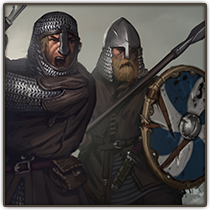
Section titled “A background is a starting profile”The background script supplies starting characteristics and economic fields; it does not lock a brother into a class. The general recruitment pool has 48 unique backgrounds, with Farmhand and Daytaler represented twice in its 50 entries. The background table shows each script’s listed hiring cost and daily wage. Treat these as script values; the final offer and a recruit’s actual strengths should be checked in the hiring screen.
Before hiring, compare current attributes, traits, level and equipment with the role your company needs. The same background can produce recruits with different individual rolls. A high listed wage also creates an ongoing cost, so compare the likely role and current company funds before spending.
Experience and perk choices
Section titled “Experience and perk choices”The 1.5.2.3 configuration lists cumulative level thresholds beginning at 0, 200, 500, 1,000, 2,000, 3,500, 5,000, 7,000, 9,000, 12,000 and 15,000 XP. It extends the table above that range. The setting MaxLevelWithPerkpoints = 11 describes the configured level range for perk-point progression; it is not a claim that veteran levels or every character rule stop at level 11.
The selectable tree contains 50 perks across its tiers. Perk effects can be conditional and can change with patches, so read the in-game tooltip before spending a point. Use the perk index to compare choices, and check dated changes such as the Fearsome adjustment in 1.5.1.
Talent stars and attribute gains
Section titled “Talent stars and attribute gains”For a standard new recruit, the script selects three distinct eligible attributes and gives each its own star roll: 1 star 60% of the time, 2 stars 30% or 3 stars 10%. This means three attributes receive stars; it does not mean three stars total. A background can exclude attributes from receiving stars; the background table marks those restrictions. A star does not add a flat amount immediately. It improves that attribute’s level-up range. Stars shown on an actual candidate are the useful evidence for that individual.
The 1.5.2.3 ranges below apply to ordinary perk-point level-ups through level 11. Veteran-level growth uses a separate minimum-only rule. Each cell shows the amount added when you select that attribute at the listed star count; the game rolls an integer within the range. A 3-star attribute raises both ends of its base range: +2 to the minimum and +1 to the maximum.
| Attribute | 0 stars | 1 star | 2 stars | 3 stars |
|---|---|---|---|---|
| Hitpoints | 2–4 | 3–4 | 4 | 4–5 |
| Resolve | 2–4 | 3–4 | 4 | 4–5 |
| Fatigue | 2–4 | 3–4 | 4 | 4–5 |
| Initiative | 3–5 | 4–5 | 5 | 5–6 |
| Melee Skill | 1–3 | 2–3 | 3 | 3–4 |
| Ranged Skill | 2–4 | 3–4 | 4 | 4–5 |
| Melee Defense | 1–3 | 2–3 | 3 | 3–4 |
| Ranged Defense | 2–4 | 3–4 | 4 | 4–5 |
As a worked example under explicit assumptions, take a level-1 Poacher with a base Ranged Skill roll of 48 and 2 stars there. That star makes each ranged-skill increase exactly 4, so selecting Ranged Skill for all ten ordinary level-ups would reach 88 before origin, trait, equipment or other later modifiers. This illustrates that growth path; it is not a recommended allocation. Compare the actual candidate and the company’s needs before spending choices.
Backgrounds such as Hedge Knight and Sellsword may join above level 1, and their background scripts define a level or level range. On joining, their starting level creates pending level-ups and perk points; those choices can still be unspent. Check the recruit’s actual stats, unspent points, equipment and level-up preview rather than treating its background as a level-1 recruit with every future choice available.
Origins change the starting constraints
Section titled “Origins change the starting constraints”An origin changes the campaign’s initial roster, resources or rules. The 16-origin index separates script-defined facts from the script’s internal DLC flag. For a first run, the tutorial walkthrough takes you through the game’s scripted opening; A New Company is the standard open campaign origin.
Unofficial fan wiki, not affiliated with Overhype Studios. Game content belongs to its owners.
Comments & feedback
Share a tip or suggest a correction. Comments appear publicly right away; display names are unverified. All language pages share this discussion. Please keep personal information private.